Intent
At Blackboys CE School, we intend to develop reflective, discerning and caring pupils who are able to develop their own beliefs and a sense of identity, while also respecting and understanding people of all faiths. We intend that every pupil will learn about and develop respect for the main world religions as due to significant global events, there is an increased need for all our pupils to receive high quality RE teaching. We intend to deepen the children’s understanding of the Christian faith through the use of the Understanding Christian scheme whilst also exploring Bible stories through our Collective Worship, local clergy and our Open the Book team. By re-visiting key RE concepts through a carefully designed sequence of learning and by creating a safe environment to ask questions in, we are enabling our pupils to develop a lifelong love of learning. Our unique settings and Christian values support the spiritual and personal development of our pupils.
Implementation
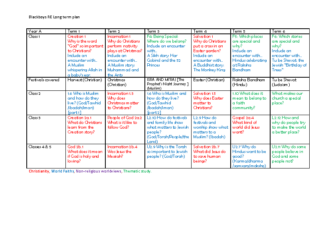
In all classes, we follow the locally agreed syllabus for East Sussex “Faith and Belief in the 21st Century” into which we have interweaved Understanding Christianity. As a Diocesan School, we ensure that we are giving the study of Christianity at last 50% of our time. Our curriculum runs on a one-year cycle in Reception, a two-year cycle in Key Stage 1, a one-year cycle for Year 3 and a three-year cycle for Years 4, 5 and 6. In Key Stage 1, we learn about Judaism in one year of the cycle and Islam in the other so that they approach the units in the correct order.
Each Christianity unit begins with reference to the Understanding Christianity Big Frieze to enable the children to see where it fits into the big story of the Bible. Every 2 years, we have a particular focus on the Big Frieze and recreate it using our own artwork and ideas. The children work together in their Houses Groups to study 2 of the panels and then try to relate the concepts shown to their own understanding of the Bible.

The syllabus suggests learning outcomes that cover the three strands of RE; theology, social sciences and philosophy, and staff ensure that each unit has coverage of all three strands. This gives our RE lessons balance and allows the children to understand what people believe and the different ways that people within a religion live their lives. This approach is also used for other world religions.
Our learning in RE is evidenced in many ways. In Reception the children work collaboratively to create a class Floor Book where the children’s artwork, photos and comments are displayed. In other year groups, the children work in their own RE exercise books. Learning takes many forms in RE and we aim to have a range of creative responses to our learning. Examples of responses are: artwork, prayers, poetry, analysing data, drama, music and reflective responses.
As a school we are beginning to think more about our own worldviews and what influences how we see things that happen in our world. We aim to give children the opportunity to develop their own views and beliefs through the use of Windows, Mirrors and Doors to help them to reflect on what they are seeing and how it makes them feel.
Alongside our weekly RE lessons, we also host an RE themed day each academic year. Every two years we re-visit the Big Frieze, looking closely at the concepts and themes within each panel and recreating the artwork for display in our school hall. On the in between years, we delve deeper into a concept that has shown to be least understood by the children over the year. Our subject leader analyses our RE data to establish which area of the RE curriculum needs more input. During these themed days, we use Drama, Dance and artwork to help us to explore the theme further.
Impact
The impact of RE is shown best through talking with our pupils about what they have learnt. They show empathy and compassion for others and an understanding of how different religions worship. Our pupil voice records show an impact of the RE lessons, themed days and learning from Collective Worship, in particular the Open the Book assemblies. The children’s reflections of the Picture News assemblies are recorded in a journal and show how the children are able to think deeply about events that are happening in the world.
At the end of each unit of work we assess how the children have understood the content of the unit, looking for those deeper reflective responses from the children who are working beyond the expected standard for their age. We have many children who are working at this level.
When our children move onto secondary school, we feel confident that they are beginning to understand their place in the world and are able to articulate their thoughts about things that are happening.